
If you’re asking “where do I get my birth certificate translated?”, you’re probably not doing it for fun.
You’re likely in the middle of a serious life process: a green card application, a visa, a U.S. passport for your child, a university admission, or a marriage-based immigration case. One incorrectly translated line, a missing stamp, or a weak certification can be enough to trigger delays, Requests for Evidence (RFEs), or, in the worst cases, refusals.
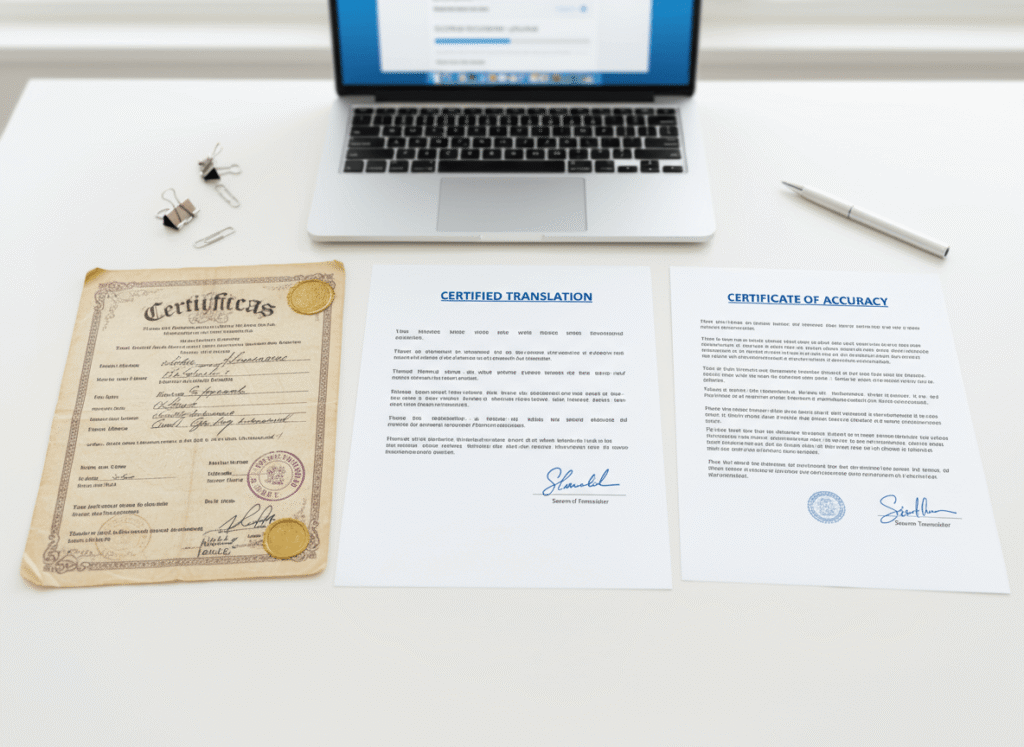
What a “Proper” Birth Certificate Translation Must Include
Before you decide where to go, it helps to be crystal-clear on what you’re actually buying.
For most immigration, consular, and university cases, a compliant translation of your birth certificate will:
- Translate every element of the document – not just the obvious bits:
- Names, dates, places of birth, registration numbers
- Stamps, seals, margins, handwritten notes and endorsements
- Follow the structure of the original so officers can easily compare both versions
- Use standard, unambiguous English wording for civil-status terms
On top of that, USCIS expects a translator’s certification attached to the translation confirming that:
- The translation is complete and accurate
- The translator is competent in both languages
- The statement includes the translator’s:
- Full name
- Signature
- Date
- Contact details (and often the language pair and document title)
Many embassies, courts, and universities use essentially the same standard, even when their exact wording differs.
The Short Answer: Best Place to Get Your Birth Certificate Translated
Most people looking up “where to get my birth certificate translated” fall into one of two groups:
- You need it for USCIS or another government authority (embassy, consulate, passport office, court), or
- You need it for a serious administrative process (university, licensing board, employer).
In both cases, the safest option is usually the same:
Use a reputable online certified translation service built around immigration work.
A specialist provider such as USCIS Official Translation offers:
- Secure upload of a clear scan or photo of your birth certificate
- Transparent, per-page pricing for standard civil documents
- Professional translators who work with USCIS-style cases every day
- A signed certificate of accuracy that follows the wording of 8 CFR 103.2(b)(3)
- Delivery in hours or 1–2 working days for typical one-page certificates
- Digital PDF plus optional printed copies for interviews or in-person appointments
If you simply want to remove the risk and move on with your application, upload your long-form birth certificate to USCIS Official Translation, confirm your quote and deadline, and let an immigration specialist handle the rest.
The rest of this guide is here to help you compare that to all your other options and decide what’s right in your situation.
All the Places You Could Get Your Birth Certificate Translated (Ranked by Risk)
People often start with the wrong end of the spectrum (machine tools, friends, whoever is cheapest) and only later discover what USCIS actually expects. Let’s walk through the most common options – from riskiest to safest – so you can decide where to get your birth certificate translated with your eyes open.
1. Free Machine Translation Tools (Google Translate, etc.)
It’s tempting: point your phone at the document, copy the English output, and you’re “done”.
For official purposes, especially immigration, this is not an option:
- Machine tools regularly mishandle names, abbreviations, and legal phrases
- They ignore context, so dates, places, and spellings can be wrong
- Most importantly, they cannot sign a certification statement – a human still has to take responsibility
Submitting a machine-generated translation for USCIS, even if you add a signature afterwards, is asking for trouble. At best, you’ll get an RFE; at worst, your evidence may be treated as unreliable.
Use machine translation only, if at all, to get a rough sense of what the document says for your own understanding – never as the version you file.
2. Friends, Family, or “Someone Who Speaks Both Languages”
U.S. regulations don’t insist on a specific job title or government licence for the translator. In theory, any competent bilingual person could translate your birth certificate and sign the certification.
In practice, there are serious drawbacks:
- They may miss subtle legal phrases or abbreviations on the certificate
- They may not know how to format the translation for a case file
- Their certification could look informal, incomplete, or inconsistent
- There’s an obvious conflict of interest when a petitioner or family member “approves” their own evidence
Immigration officers have discretion. If something looks improvised or biased, they can question it, request a new certified translation, or ask for further evidence – adding months to your timeline.
If you genuinely have no alternative, make absolutely sure the person:
- Translates every detail, including seals and margins
- Uses a proper certification template that mentions competence, completeness, and accuracy
- Is willing to be reachable and contactable if a case officer has questions
But for most applicants, especially with time-sensitive cases, this option is simply too risky.
3. A Local Notary Public or Law Office
Many people assume “notary = translation”. Usually, that’s a misunderstanding.
- Notaries typically do not translate; they witness signatures
- A notary can notarise the translator’s signature, but that’s in addition to, not instead of, a certified translation
- Clerks or staff in a law office may be multilingual, but not trained as professional translators
This route can work if the firm partners with a reputable translation provider behind the scenes. In reality, it’s often slower and more expensive than simply going straight to a specialist service.
For USCIS, notarisation is usually not required – what matters is a proper certified translation with a compliant translator’s statement.
4. Local Walk-In Translation Agencies
In many cities, especially near consulates or court districts, you’ll find small translation shops that advertise “certified translation” for birth certificates.
Advantages
- You can speak to someone face to face
- It’s easy to show original documents if necessary
- Some offer same-day service for straightforward certificates
Disadvantages
- Limited locations and opening hours
- Quality and pricing vary widely from shop to shop
- Not all are familiar with USCIS-style wording and expectations
If you go this route, ask exactly the same questions you would ask online:
- Do you regularly prepare translations for USCIS or consular cases?
- What does your certificate of accuracy say, and what information does it include?
- How long is the turnaround for a one-page birth certificate?
5. Your Consulate or Embassy
Some embassies and consulates offer translation services or maintain a list of recommended translators for local civil documents. This can be helpful if you need:
- A translation specifically for your home country’s authorities, or
- A sworn/official translation under that country’s legal system
However:
- These services may not be optimised for USCIS or U.S. university requirements
- Processing times can be long
- In many countries, the consulate will refer you to private translators rather than translating in-house
If your birth certificate translation must also be used in your home country’s courts or civil registry, check their guidance – but don’t assume that a consular translation automatically meets U.S. immigration expectations.
6. Professional Online Certified Translation Services (Best Overall Choice)
For most people searching “where to get my birth certificate translated”, the most efficient and reliable answer is:
A professional online certified translation service that specialises in immigration and official documents.
Modern providers like USCIS Official Translation combine:
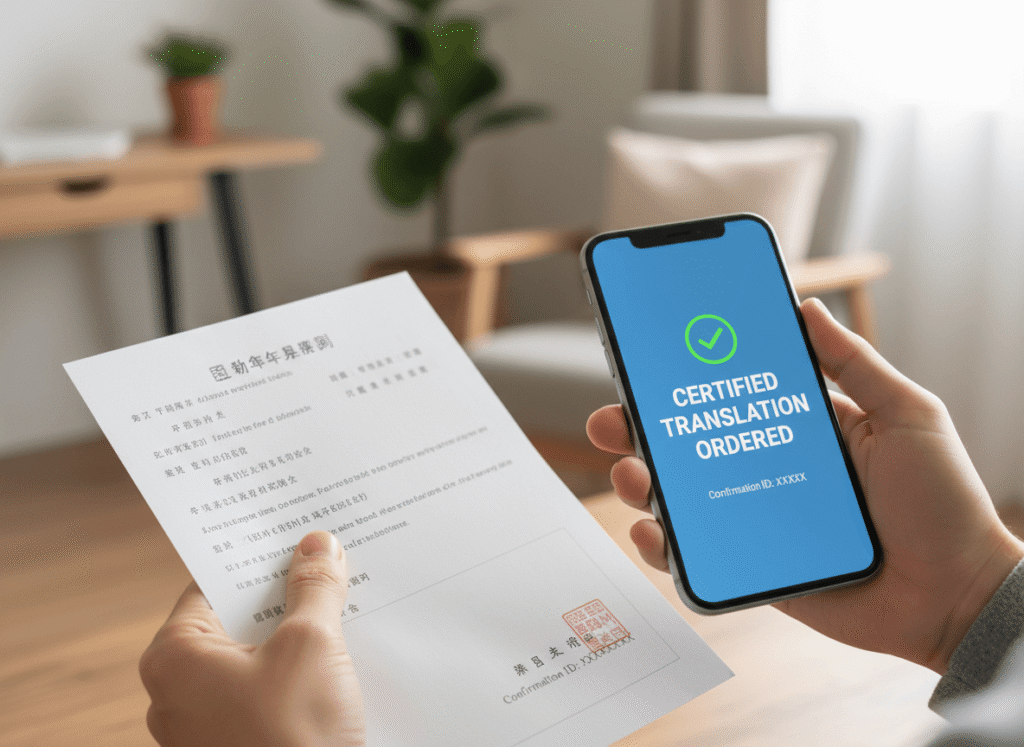
- Simple ordering – upload a scan or high-resolution photo from anywhere in the world
- Transparent pricing – typical U.S. market rates for birth certificates are around $20–40 per page for common languages, depending on provider and urgency
- Fast turnaround – from a few hours to 1–2 working days for standard certificates
- USCIS-style certification – wording aligned with 8 CFR 103.2(b)(3) and immigration practice
- Digital delivery – a PDF ready to print and include with your application, plus optional hard copies
Because everything is handled online, you can sort your translation out in a single sitting: locate your long-form certificate, take a clear photo, upload it, confirm the quote, and then wait for the certified English version to arrive in your inbox.
If you want a single, low-risk answer to “where should I get my birth certificate translated?”, this is it

How to Choose the Right Provider in 5 Minutes
Whether you decide on a local agency or an online service, use this simple checklist to evaluate where you’ll get your birth certificate translated.
1. Compliance with USCIS rules (even if you’re not filing there yet)
Ask them, plainly:
- “Will my translation include a signed certification confirming it is complete and accurate, and that the translator is competent in both languages, as required by 8 CFR 103.2(b)(3)?”
If they hesitate, or don’t know what that regulation refers to, that’s a warning sign.
2. Experience with birth certificates and immigration
Look for signs that they regularly handle:
- Birth, marriage, and civil status documents
- USCIS filings (I-130, I-485, N-400, K-1, etc.), consular cases, and university admissions
- Requests for Evidence (RFEs) where a better translation was needed
Specialist providers such as USCIS Official Translation openly position themselves around USCIS requirements, which is exactly what you want for this type of document.
3. Transparent pricing and turnaround
Reliable services typically publish:
- A clear per-page or per-word rate
- Standard vs rush timeframes (for example, 24–48 hours for civil documents)
- Policies for revisions or re-issues if an officer asks for clarification
4. Data security and confidentiality
Birth certificates contain sensitive personal information. Check:
- How files are uploaded (encrypted forms/portals vs email attachments)
- How long they store documents before deletion
- Whether they have NDAs or confidentiality policies for corporate or legal clients
5. Acceptance track record
Look for:
- References to USCIS acceptance
- Testimonials from immigration lawyers or previous applicants
- Clear statements about what happens if an officer questions the translation
Step-by-Step: Getting Your Birth Certificate Translated Today
Once you’ve chosen where you’ll get your birth certificate translated, the process itself is straightforward.
Step 1 – Find the right version of your birth certificate
Where possible, use the long-form version that shows:
- Your full name
- Date and place of birth
- Parents’ full names
- Official seal and issuing authority
- Registration numbers or margins with extra notes
If your certificate is short, missing details, or partly illegible, request a fresh copy from the civil registry before translating.
Step 2 – Scan or photograph it clearly
- Lay the certificate flat in good light
- Capture front and back if both contain information
- Make sure stamps, signatures, and handwritten notes are legible
- Save as PDF or high-resolution image (JPG/PNG)
A translation is only as good as the copy the translator can actually read.
Step 3 – Upload to your chosen translation service
With an online provider like USCIS Official Translation, you’ll typically:
- Upload your scan or photo through a secure form
- Specify the language pair (for example, Arabic → English, Spanish → English)
- Indicate the purpose (USCIS, embassy, passport, university, etc.)
- Confirm any deadline (interview date, filing window, appointment)
You’ll then receive a clear quote and delivery estimate. There’s no need to post originals purely for translation.
Step 4 – Translation, review, and certification
Behind the scenes, a professional translator will:
- Mirror the layout of your birth certificate so it’s easy to compare
- Translate every element, including small notes and margins
- Standardise names, dates, and place spellings across documents
- Add translator’s notes only where necessary (for example, “illegible stamp”)
A second linguist or reviewer often double-checks key data, especially names and dates, before the certification is signed.
The final package should include:
- The English translation
- A certificate of accuracy signed and dated by the translator or agency
Step 5 – Receive, check, and submit
You’ll usually receive a certified PDF by email. Before you file:
- Check that names appear exactly as in your forms
- Confirm dates, places, and numbers
- Make sure the translator’s certificate is attached and signed
Then:
- Print the translation and certification
- Attach them to a copy of the original birth certificate
- File the bundle with your USCIS application, consular package, or university documents following the relevant instructions
Do You Need Notarised, Apostilled, or Sworn Translations?
For USCIS itself, the regulation talks about a certified translation, not a notarised one. As long as the translator’s certification meets the 8 CFR 103.2(b)(3) standard, that is usually enough.
However, you may need notarisation or additional formalities in certain situations:
- Court filings in some U.S. states
- Foreign consulates with their own rules
- Some professional licensing boards or universities
- Authorities in countries that require sworn translators under local law
In these cases, you can:
- Order a standard certified translation first
- Then request optional notarisation or apostille from the same provider, or through a notary/consulate, if required
Frequently Asked Questions: Where to Get Your Birth Certificate Translated
1. Where should I get my birth certificate translated for USCIS?
For USCIS, the safest option is a professional certified translation service that regularly handles immigration cases. They’ll provide a full English translation plus a signed certification that meets the 8 CFR 103.2(b)(3) standard. Online specialists such as USCIS Official Translation are built specifically around USCIS expectations, which makes them a strong choice for birth certificates and other vital records.
2. Can I translate my own birth certificate?
The regulation focuses on the translator’s competence and certification, not their job title or relationship to you. Technically, a competent bilingual person – including you – could translate your own birth certificate.
However, self-translation of vital records is risky. Officers can view it as biased or unreliable, and many immigration practitioners strongly recommend using a neutral professional for birth, marriage, and criminal records.
3. Does my translation need to be notarised?
For most USCIS applications, no. USCIS requires a certified translation – the translation plus a signed statement from the translator confirming its completeness and accuracy and their competence in both languages. Notarisation is normally optional and only required when another authority (such as a court or foreign consulate) asks for it.
4. Can I use the same translation for USCIS and my embassy or consulate?
Often, yes. A properly prepared certified translation of your birth certificate is frequently accepted by:
- USCIS
- U.S. embassies and consulates
- Universities and colleges
- Some licensing boards and employers
However, some authorities may require additional steps (such as notarisation or an apostille) or have time limits on how old the translation can be. If you plan to reuse your translation, tell your provider in advance so they can advise on the best format.
5. How much does it usually cost to translate a birth certificate?
In the U.S. market, certified translations of standard one-page birth certificates typically cost around $20–40 per page for common languages, with higher rates for rush services or rare languages.
USCIS Official Translation, for example, offers per-page pricing with clear turnaround options, so you know the cost before you confirm your order.
6. How long does a birth certificate translation take?
For most providers, a single-page birth certificate can be translated and certified in 24–48 hours, with same-day or weekend rush options available for urgent cases.
If you’re facing a specific deadline (such as a USCIS interview or consular appointment), choose a service that offers guaranteed delivery windows and tell them your date upfront.
