
If you’re typing “where can I translate my birth certificate” into a search bar, you’re probably in the middle of something important: an immigration application, a visa, a passport renewal, a Real ID, or a university enrolment. In all of these situations, a birth certificate is more than a piece of paper – it’s proof of identity, nationality, and family ties.
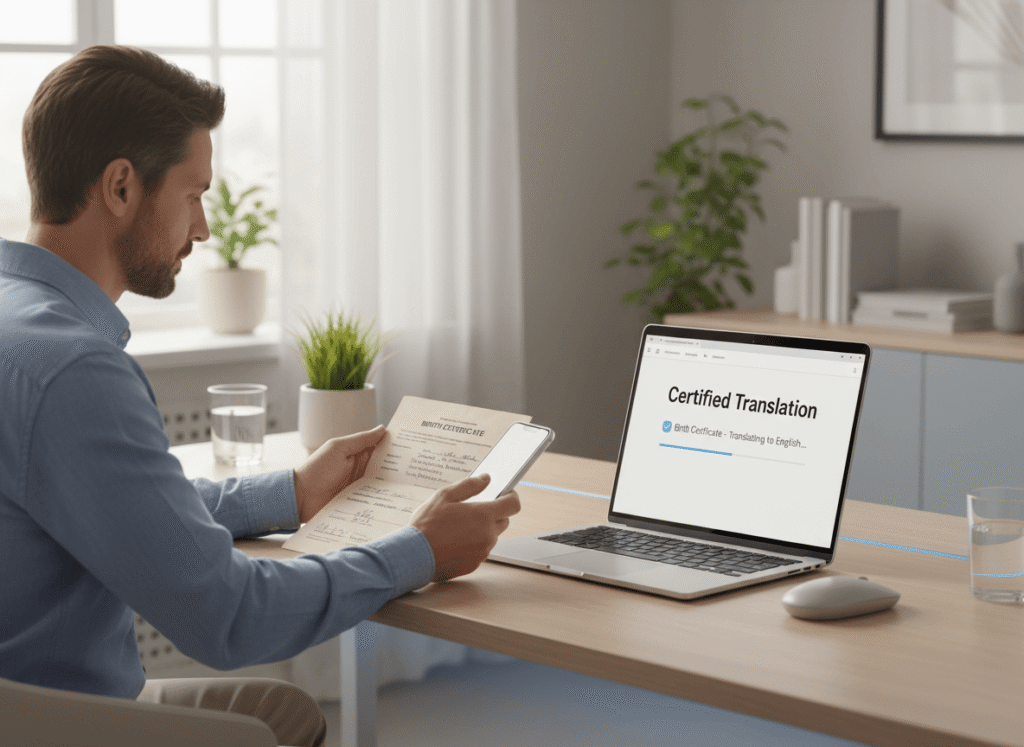
The short answer: the safest place to translate your birth certificate
You have several options for translating a birth certificate, but if your goal is immigration, visas, or other government procedures, the safest and most efficient option is usually:
A specialist online service that provides certified birth certificate translations specifically for USCIS and other U.S. authorities.
A dedicated immigration-focused provider like USCIS Official Translation:
- Delivers a full, line-by-line English translation of your birth certificate
- Includes the required translator’s certification stating the translation is complete and accurate, and that the translator is competent in both languages
- Knows how to handle non-Latin scripts (Arabic, Cyrillic, Chinese, etc.) and name transliteration
- Understands the formatting expectations of USCIS, the U.S. Department of State, DMVs, courts, and universities
- Works entirely online, so you don’t have to search for “birth certificate translation near me”
What authorities actually want from a birth certificate translation
Before deciding where to translate your birth certificate, it helps to understand what the receiving authority requires.
Across most U.S. immigration and government processes, the core rule is very similar:
Any document in a foreign language submitted with your application must be accompanied by a full English translation plus a certification from the translator confirming completeness, accuracy, and competence.
USCIS and immigration applications
USCIS references this requirement in federal regulations and form instructions for applications like naturalisation, adjustment of status, waivers, and more.
For a USCIS birth certificate translation, you must normally provide:
- A full English translation (no summaries or partial translations)
- A signed certification from the translator or translation company stating:
- They are competent in English and the original language
- The translation is complete and accurate
- The translation is dated and signed, often with contact details
Professional organisations such as the American Translators Association (ATA) reinforce these requirements and recommend that applicants use experienced, independent translators rather than translating their own documents.
Passports, U.S. consulates, and foreign embassies
For U.S. passports, the Department of State often applies a similar standard: foreign-language civil documents (including birth certificates) generally need certified English translations when requested.
Some U.S. embassies and consulates go further and only accept translations from specific authorised bodies or translators. For example, certain embassies accept translations only from government ministries, court-appointed translators, or approved lists.
State DMVs, courts, and universities
State-level agencies and institutions such as:
- Departments of Motor Vehicles (DMVs)
- Family and probate courts
- Universities and scholarship bodies
commonly require a certified translation of your birth certificate when it’s used as proof of identity, age, or family relationship.
Each may have its own rules – for example, some courts want notarised translations or specific wording in the certificate, and some universities insist on professional or institutional translators.
Because the standards vary, a provider that routinely handles USCIS and government work can help you meet the strictest standard and avoid redoing your translation later.
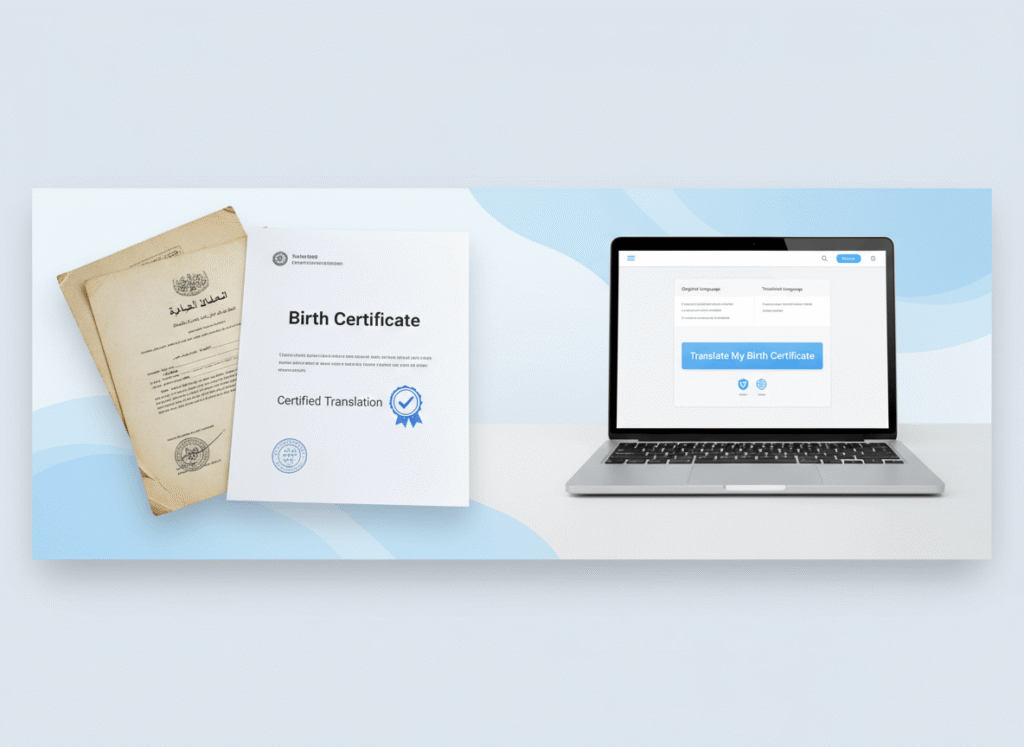
Where can you translate your birth certificate? 5 main options
1. Specialist online certified translation services (recommended)
The most straightforward solution for most people is a specialist online service that focuses on immigration and official document translation.
A provider like USCIS Official Translation offers:
- Online ordering: upload a scan or photo of your birth certificate from anywhere in the world
- Certified birth certificate translation for USCIS, consulates, DMVs, and universities
- Experience with hundreds of language pairs and non-Latin scripts
- A clear translator’s certificate attached to the translation, satisfying USCIS wording requirements
- Secure handling of sensitive personal data and payment information
Instead of searching endlessly for “where can I translate my birth certificate near me”, you can start directly on a focused service page such as USCIS birth certificate translation services and complete the process in minutes.
Once your file is uploaded and your details are confirmed, a professional translator prepares the translation, it passes through quality checks, and you receive a USCIS-ready PDF plus optional printed copies if you ask for them.
Next step: Upload your birth certificate securely to USCIS Official Translation and receive a certified translation with a fast, reliable turnaround – ready to attach to your immigration or government application.
2. Local translation agencies and notary offices
You can also translate your birth certificate through local language service providers, including:
- Traditional translation agencies in your city
- Notary publics who work with translators
- Law firms with in-house or partner translators
This can be useful if you prefer in-person service or need notarisation at the same time. However, there are some questions you should always ask:
- “Will you provide a written certification statement with the translation?”
- “Are you familiar with USCIS and U.S. consulate requirements?”
- “Can you match the formatting of the original birth certificate?”
- “Can you deliver both a digital copy and physical copies if needed?”
Local services can be excellent, but they may have limited language coverage, higher costs, or slower turnaround compared with specialist online providers.
3. Embassies, consulates, and government-affiliated translators
In some countries, certain authorities require that birth certificates be translated by:
- Government translation offices
- Court-sworn translators
- Translators on official consular lists
For example, some U.S. embassies only accept translations performed or certified by a particular ministry or authorised agency in that country.
This route can be essential when:
- You need a translation that will be used both in your home country and the U.S.
- The local civil registry office will only issue an official translation
- Your birth certificate needs legalisation or an apostille along with the translation
The downside? These services may be slower, require in-person visits, and may not give you a digital copy formatted the way USCIS prefers. Many applicants prefer to use USCIS Official Translation for the U.S. side of the process, even if they also obtain a local translation for other uses.
4. Universities, language departments, and community organisations
For some lower-stakes uses (for example, internal school records), people sometimes turn to:
- University language departments
- Community organisations and cultural centres
- Language teachers they know personally
While these can sometimes provide competent translations, they don’t always issue the type of formal certification that USCIS or a consulate expects.
If you do use this route, confirm in advance:
- That the translator will sign a certification statement
- That the statement clearly mentions the translator’s competence, and that the translation is complete and accurate
- That you can obtain printed and/or digital copies for your application bundle
In practice, many applicants choose to use these options only for informal or personal needs, and rely on a certified online service for official submissions.
5. Self-translation or a friend translating: why it’s risky
You’ll find conflicting information online about whether you can translate your own birth certificate. That’s because different websites interpret the regulations differently.
The underlying federal rule focuses on the translation being complete, accurate, and accompanied by a translator’s certification; it does not expressly require the translator to be a member of a specific professional body.
However, authoritative guidance from professional organisations and experienced immigration practitioners strongly warns against self-translation:
- It can create a conflict of interest, since you have a direct stake in the outcome
- An officer may question the reliability of a translation signed by the applicant or a close family member
- If anything looks inconsistent, you risk RFEs or delays, especially now that officers are paying closer attention to multilingual documents
Some agencies and law firms state outright that USCIS will not accept self-translated birth certificates. Even where this is based on interpretation rather than explicit statute, it reflects a very conservative, risk-averse approach.
For something as critical as your immigration or passport case, it’s usually not worth the gamble. A relatively low-cost professional translation is far cheaper than the cost of re-filing, losing filing fees, or delaying status by months.
When in doubt, let an independent professional handle your USCIS birth certificate translation rather than doing it yourself.
How to choose the right birth certificate translation service
Once you know where you can translate your birth certificate, the next question is which provider to trust.
Here’s a practical checklist drawn from industry guidance and comparative reviews of birth certificate translation services:
1. Acceptance track record
Look for:
- Experience with USCIS, NVC, U.S. consulates, and state agencies
- Clear mention that translations are suitable for immigration and official use
- Real testimonials mentioning successful USCIS submissions or visa approvals
2. Proper certification wording
Confirm that the provider includes:
- A signed statement on the translator’s or company’s letterhead
- Wording that states the translation is complete and accurate
- A statement that the translator is competent in both languages
- Signature, name, and date, and often contact details
USCIS Official Translation builds this certificate into every certified translation of a birth certificate, so you don’t have to draft it yourself.
3. Language and script expertise
For non-Latin scripts (Arabic, Chinese, Cyrillic, Thai, etc.), it’s vital that the translator:
- Understands transliteration rules for names
- Knows how to handle multiple spellings consistently across your documents
- Recognises local civil registry formats so nothing is overlooked
4. Transparent pricing and timelines
Trustworthy providers usually:
- Display per-page or per-word pricing
- Offer clear options for standard vs urgent delivery
- Provide realistic timelines rather than promising impossible turnaround times
5. Security and confidentiality
Your birth certificate contains sensitive personal information. Make sure the service:
- Uses secure, encrypted upload and payment systems
- Has clear confidentiality policies
- Trains staff to handle identity documents properly
6. Human translation, not generic machine output
Machine translation tools are improving, but they’re not suitable for official birth certificate translations. Small errors in:
- Names
- Dates
- Places of birth
- Legal wording
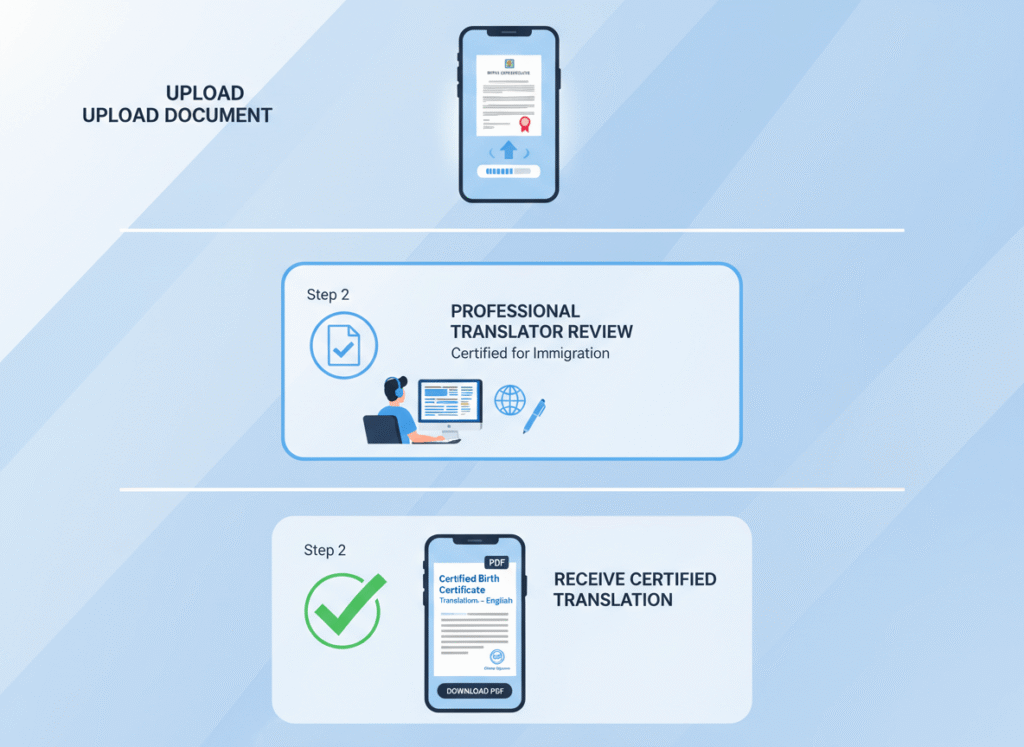
Step-by-step: translating your birth certificate with USCIS Official Translation
Here is what the process typically looks like when you choose USCIS Official Translation for your birth certificate translation services:
Step 1: Upload your birth certificate securely
Take a clear scan or photo of:
- The front and back of your birth certificate (if both contain text)
- Any margins or stamps with relevant information
Then upload them through the secure order form on our USCIS birth certificate translation page (for example, /birth-certificate-translation/).
Step 2: Confirm languages and purpose
Specify:
- The source language (the language of the original certificate)
- The target language (usually English for USCIS and U.S. agencies)
- The primary purpose: USCIS, consulate, DMV, court, university, or other
This allows our translators to align the translation with the expectations of the receiving authority.
Step 3: Receive a clear quote and turnaround time
You’ll see:
- A simple per-page price
- The estimated delivery time for your certified birth certificate translation
- Any options for urgent service if your deadline is close
Once you approve and pay securely online, your order is assigned to a qualified translator experienced with civil-status documents.
Step 4: Translation, quality check, and certification
Your translator:
- Reproduces all names, dates, places of birth, and official wording accurately
- Transliterates names where needed, while keeping consistency with your other documents
- Formats the translation so it’s clear which part corresponds to each portion of the original
After quality checks, we prepare the translator’s certification and attach it to your translation.
Step 5: Receive your USCIS-ready translation
You then receive:
- A digital PDF of your certified birth certificate translation
- The translator’s certification statement
- The option to request printed copies if a court, university, or agency needs them
Frequently Asked Questions
1. Where can I translate my birth certificate for USCIS?
You can translate your birth certificate for USCIS through a certified translation service that regularly works with immigration cases, such as USCIS Official Translation. These services provide a full English translation plus a translator’s certification, which is what USCIS expects for foreign-language documents.
2. Do I need a “near me” service to translate my birth certificate?
No. For most USCIS and immigration cases, you don’t need a local office. You can use online birth certificate translation services and receive a certified translation digitally, which is accepted by USCIS and many other authorities. Many top-ranking providers emphasise that you do not need to visit a physical office to translate your birth certificate.
3. Who can translate my birth certificate?
Legally, the key requirement is that the translator is competent in both languages and provides a signed certification stating the translation is complete and accurate.
However, to minimise risk, it is generally recommended to use:
- A professional translator
- A reputable translation company specialising in certified translations for immigration and official use
Using a friend, family member, or yourself as the translator can raise questions about bias and reliability, and may increase the risk of RFEs.
4. Can I translate my own birth certificate?
While the regulation focuses on the translation being certified and accurate, not on a particular licence, many practitioners caution against self-translation for USCIS cases.
Translating your own birth certificate may:
- Create a conflict of interest
- Make it easier for an officer to question the translation’s reliability
- Lead to additional scrutiny or RFEs
For immigration, passports, and other high-stakes applications, it is safer to use a professional, independent translator and obtain a formal certified birth certificate translation.
5. How long does a birth certificate translation take?
Timelines vary between providers, but many online translation services offer:
- Standard delivery within about 24–48 hours for a typical one-page birth certificate
- Urgent delivery for tighter deadlines, often the same or next business day, at a higher fee
At USCIS Official Translation, turnaround is designed to be fast while still allowing for careful quality checks and proper certification.
6. How much does birth certificate translation cost?
Pricing depends on:
- The language pair
- The length and complexity of the certificate
- Whether you need urgent delivery, notarisation, or extra copies
Many immigration-focused providers charge a flat per-page rate and highlight typical price ranges to keep things simple
