
Certificate of Translation
If you’re submitting documents in a foreign language to USCIS, an immigration court, a university, or a government office, you’ll almost always be asked for a certificate of translation alongside the translated document. Get this wrong and you risk delays, RFEs, or outright refusals. Get it right, and your application moves forward smoothly.
What Is a Certificate of Translation?
A certificate of translation (often called a certificate of translation accuracy or translation certification statement) is a signed statement from the translator or translation company confirming that:
They are competent in both languages, and
The translation is complete, accurate, and faithful to the original document.
It is usually attached to, or included on, the translated document and printed on the translator’s or agency’s letterhead.
Simple Definition
A certificate of translation is a written, signed declaration from the translator or translation provider confirming that the translation is complete, accurate, and produced by someone competent in both languages.
In the United States, federal regulations require that any non-English document submitted to immigration authorities is accompanied by:
A full English translation, and
A certification from the translator that:
The translation is complete and accurate, and
The translator is competent to translate from the foreign language into English.
Certificate of Translation vs Certified Translation vs Notarised Translation
Because competitors and even government templates sometimes mix terminology, it’s easy to get confused. Here’s the clear difference:
Certified Translation
A certified translation is:
A word-for-word translation of a document,
Accompanied by a certificate of translation (the signed statement) on letterhead,
Suitable for official use (USCIS, courts, universities, professional bodies, etc.).
According to the American Translators Association (ATA), in the U.S. a translator does not need to be “certified” to provide a certified translation; any competent translator or company representative may certify their own translation.
Certificate of Translation
The certificate of translation is the actual statement (usually a short paragraph or form) that:
Names the translator or agency,
States the languages involved,
Identifies the document translated,
Confirms accuracy and completeness,
Includes signature, date, and contact details.
Think of it as the translator’s signed promise that the translation can be trusted.
Notarised Translation
A notarised translation means a notary public has officially witnessed the translator’s signature on the certificate of translation.
The notary is not certifying the translation itself, only the identity and signature of the person who signed the certificate.
Some courts, state agencies, or universities may request this extra step; many do not.
At USCIS Official Translation, we provide:
Certified translations with a robust certificate of translation, and
Optional notarisation if your case or jurisdiction requires it.

When Do You Need a Certificate of Translation?
You will typically need a certificate of translation whenever you submit a foreign-language document to an authority that must rely on the English version.
Common situations include:
USCIS immigration cases
Green card, visa, and naturalisation applications
Asylum cases and waivers
Immigration courts (EOIR) & federal courts
State agencies and DMVs (driver’s licences, ID cards)
Universities and professional bodies
Academic transcripts, diplomas, letters of reference
Civil status & family law matters
Birth, marriage, and divorce certificates
Adoption records, custody documents
Financial and corporate documents
Bank statements, company registrations, contracts
If your request letter or instructions mention any of the following, you almost certainly need a certificate of translation:
“Certified translation required”
“Certificate of translation must be attached”
“Translation must be certified as accurate and complete”
“Translator must be competent and sign a certification statement”
What Must a Valid Certificate of Translation Include?
Government templates from immigration courts, state agencies and legal aid organisations all include very similar elements, even if their wording varies.
A strong document translation certification should include:
Translator’s full name
Statement of competence, e.g. that the translator is fluent in English and the source language
Language pair (e.g. Spanish into English)
Identification of the document (title/description, sometimes date)
A clear statement that the translation is:
Complete (no omissions or summaries)
Accurate (faithful to the original)
Signature of the translator (hand-signed or secure e-signature)
Date of certification
Contact details (address, phone, email, and/or company details)
Company letterhead or official formatting (highly recommended)
Optional: notarial block if notarisation is required
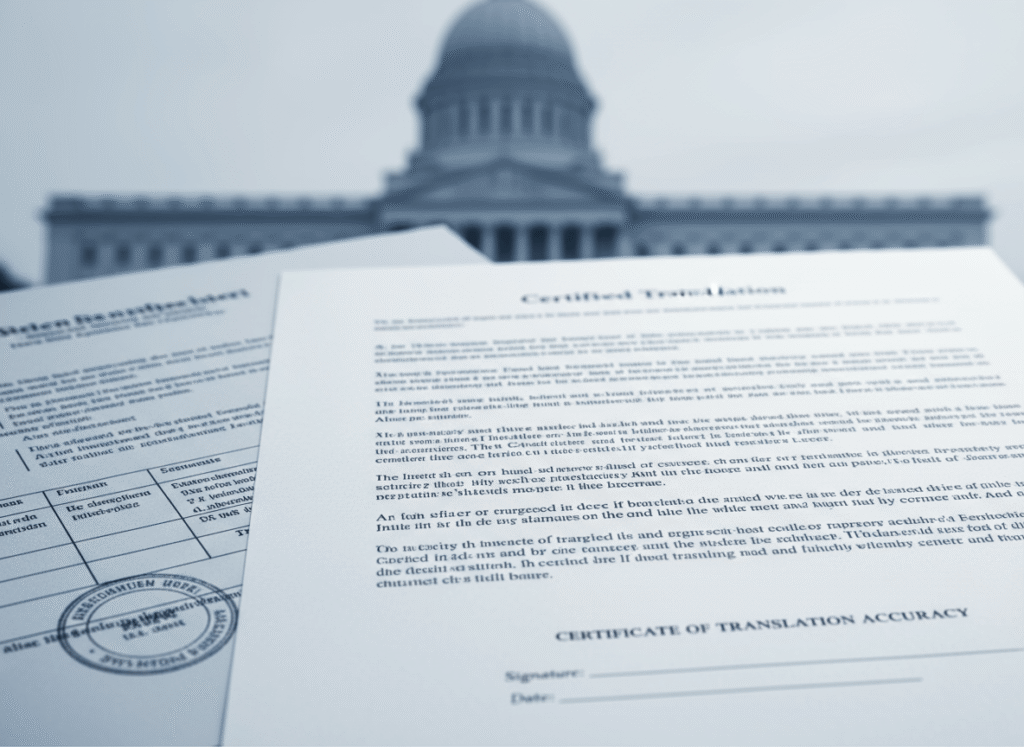
Recommended Translation Certification Statement (Example)
Below is a certified translation example of the kind of wording commonly accepted by immigration authorities and courts. You can use it as a reference if you need to understand the structure:
Sample translation certification statement
“I, [Translator’s Name], certify that I am fluent in English and [Language] and that the attached translation of [description of document] is a complete and accurate translation of the original to the best of my knowledge and ability.”
A full certificate of translation template will also include:
Translator’s signature and printed name
Date of certification
Translator’s or agency’s postal address and contact details
Free Certificate of Translation Template (Text You Can Reuse)
If you need a basic certified translation template for reference, you can adapt the following structure. For legal and immigration matters, we strongly recommend using a professional provider, but this shows you the typical contents.
Certificate of Translation – Editable Text Template
CERTIFICATE OF TRANSLATION
I, ____________________________________________, certify that I am fluent in English and _____________________________________ and that I am competent to translate from that language into English.
I further certify that the attached translation of the document entitled ____________________________________________ is a complete and accurate translation of the original document to the best of my knowledge and ability.
Translator’s Signature: _______________________________
Translator’s Printed Name: _____________________________
Date: _____________________
Address: _____________________________________________
Telephone / Email: _____________________________________This is for information and comparison. When you order from USCIS Official Translation, we handle all of this on your behalf and issue a professionally formatted certificate of translation accuracy with every certified translation.
How to Get a Certified Translation with Certificate (Step-by-Step)
If you’re wondering how to get certified translation and a valid certificate of translation, the safest route is to use a specialist provider that works with immigration and legal documents every day.
How It Works with USCIS Official Translation
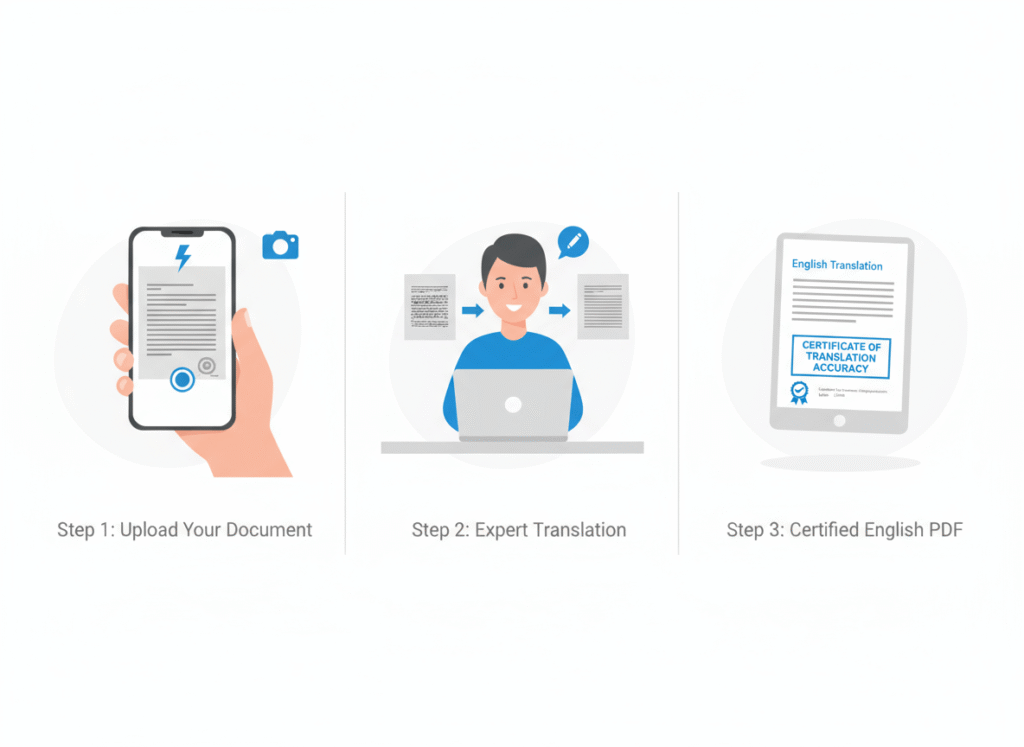
Step 1 – Upload your file
Click “Upload Your File” and send us a clear scan or photo of your document (both sides, if applicable). We accept PDFs, images, and office file formats.
Step 2 – Get an instant quote
We review your document and provide transparent pricing based on language pair, length, and any extra services (e.g. notarisation, hard copies).
Step 3 – Professional human translation
A qualified legal/immigration translator prepares a word-for-word translation, following the layout of your original document wherever practical so officials can compare both easily.
Step 4 – Certificate of translation issued
We add a translation certification statement on our letterhead, signed by the translator or authorised representative, confirming accuracy and competence.
Step 5 – Delivery & optional hard copies
You receive a digital PDF ready to upload or print. On request, we can also post hard copies with wet signatures and, if needed, a notarised certificate of translation.
Special Focus – Certificate of Translation Spanish to English
One of the most common needs worldwide is a certificate of translation Spanish to English, especially for:
Birth certificates
Marriage and divorce decrees
Police records and court decisions
Academic transcripts and diplomas
USCIS, immigration courts, and many consular posts routinely require these documents to have a full English translation with a certification statement.
At USCIS Official Translation:
We work with specialist Spanish–English translators experienced in immigration and legal terminology.
Every translation includes a certificate of translation accuracy that follows the expectations of USCIS, EOIR, and other U.S. authorities.
Where appropriate, we can ensure our process is aligned with best practice promoted by professional associations such as the American Translators Association (ATA).
Document Translation Certification for Immigration, Courts & Universities
Typical Documents That Need Certification
Common foreign-language documents that require document translation certification include:
Birth, marriage, and divorce certificates
Passports and ID cards
Police clearances and court records
Academic transcripts, diplomas, degree certificates
Bank statements, payslips, employment letters
Adoption records and guardianship documents
Who Can Sign the Certificate?
Under U.S. rules, any competent person fluent in both languages may certify their own translation – but that does not mean every translation will be accepted or trusted.
Authorities tend to prefer:
A professional translator,
A reputable translation company, or
Where relevant, a translator with recognised credentials (for example, ATA-certified translators for ATA certified translation services in certain professional contexts).
Using a specialist provider like USCIS Official Translation significantly reduces the risk of:
RFEs (Requests for Evidence)
Rejections due to missing or incomplete certificates
Delays caused by unclear or non-standard formatting
Example – Certified Translation Template for a USCIS Application
To help you visualise what you receive, here’s what a certified translation example might include in practice:
Cover page with agency name and logo
Translated document, mirroring the structure of the original
Certificate of translation on letterhead, including:
Translator or authorised signatory’s name
Statement of competence and accuracy
Languages (e.g. Arabic into English)
Document description
Signature, date, and contact details
Why Choose USCIS Official Translation for Your Certificate of Translation?
Built for Immigration & Legal Use
Our workflows follow the expectations set out in U.S. regulations and guidance used by immigration practitioners, meaning your documents are prepared with official use in mind, not just general translation.
Human Experts, Clear Accountability
Professional human translators specialising in legal and immigration content
Multi-stage review before certification
Named translators and traceable certificates for extra peace of mind
Fast Turnaround, Global Access
Whether you’re applying from San Jose, New York, London or overseas, our online platform lets you order certified translation with a proper certificate of translation from anywhere, at any time. (If you’re looking for local support, see our dedicated translation services San Jose page.)
Trust Signals & Social Proof
Used by immigration lawyers, relocation firms, and education consultants worldwide
Clear, written guarantees on accuracy and completeness of every certified translation
Strict confidentiality and data protection procedures
FAQs: Certificate of Translation
Do I really need a certificate of translation for USCIS?
Yes. U.S. immigration rules state that any non-English document submitted must be accompanied by a full English translation and a certification from the translator confirming accuracy and competence.
What should a translation certification statement say?
A solid translation certification statement should:
Identify the translator,
Confirm fluency in English and the source language,
State that the translation is complete and accurate, and
Be signed and dated, ideally on official letterhead
Can I certify my own translation?
Technically, yes – U.S. regulations allow you to certify your own translation if you are competent in both languages and provide a proper certificate of translation. However, immigration practitioners and official guidance strongly recommend using professional certified translation services to avoid mistakes and delays.
What is the difference between an ATA-certified translator and a certified translation?
An ATA-certified translator is a translator who has passed a professional examination by the American Translators Association, gaining a respected credential that demonstrates translation competence.
A certified translation, on the other hand, is about the document: a translation accompanied by a certificate of translation. You can have:
Certified translations produced by ATA-certified translators, or
Certified translations produced by other qualified professionals.
Is a certificate of translation enough for court or university use?
Most of the time, yes – a properly worded certificate of translation is sufficient. However, some courts, universities or licensing bodies may ask for:
Notarised certification of the translator’s signature, or
Additional documents (e.g. translator CV, professional membership evidence).
Do you provide hard copies and notarised certificates?
Yes. We can:
Email you a PDF copy of your certified translation and certificate of translation, and
Ship hard copies with original signatures, and where requested, notarised certificates of translation suitable for court filings or applications that require notarisation.
Pricing plans
Choose the plan that suits your needs—transparent, flat-rate pricing with no hidden fees.
Basic
Certified translation on official letterhead with unlimited minor edits for $24.99/page.
Standard
Everything in Basic + 12-hour Rush service (+ $10/page).
Sworn
Official translation signed and sealed by a sworn translator, accepted by courts and authorities.